
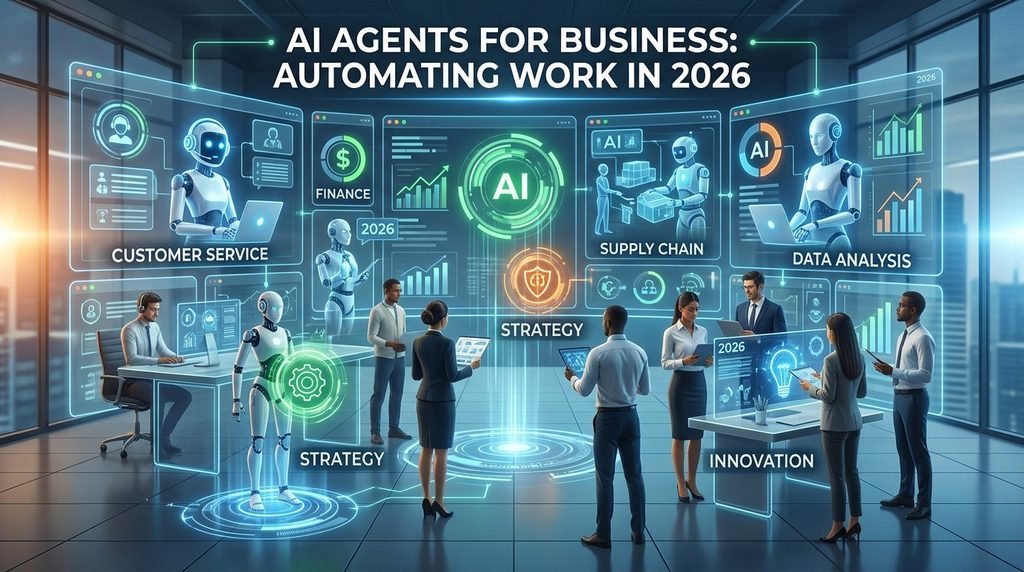
AI is moving beyond simple question-and-answer systems.
The next stage is the use of AI agents: systems designed to work through multi-step tasks, interact with business tools and help complete workflows with human oversight.
For companies, this creates a new opportunity to rethink how everyday work is performed.
What Is an AI Agent?
A traditional chatbot generally waits for a question and produces an answer.
An AI agent can be designed to work toward a goal.
For example, a business workflow might involve:
- Receiving a customer request
- Understanding the request
- Checking available information
- Creating a record
- Preparing a response
- Sending a notification
- Asking a human for approval when necessary
The exact capabilities depend on the software and permissions available.
Where Can Businesses Use AI Agents?
Customer Service
Agents can help classify customer requests, retrieve information and prepare responses.
Sales
AI can assist with lead research, follow-up preparation and CRM workflows.
Finance
Businesses can use automation to organize documents, identify unusual transactions and prepare information for review.
Human Resources
AI can help organize employee information, draft communications and answer routine policy questions.
Software Development
AI systems can assist developers with code, documentation, testing and issue analysis.
Why Businesses Are Interested
The attraction is straightforward: repetitive work consumes time.
If an AI system can safely handle part of a repetitive process, employees can focus more heavily on work requiring judgment, communication and accountability.
Microsoft’s 2026 Work Trend Index describes this broader shift toward AI and agents taking on more execution while humans increasingly direct and evaluate work.
The Biggest Risk: Giving AI Too Much Authority
Businesses should not assume that an AI agent should have unrestricted access.
A safer approach is to define:
- What information it can access
- Which applications it can use
- What actions require approval
- What it is prohibited from doing
- How activity is logged
- How mistakes are detected
Human oversight is particularly important when an action could affect money, customers, employees or sensitive information.
How to Start
Companies considering AI agents should begin with one clearly defined workflow.
For example:
Invoice received → information extracted → accounting record prepared → human approval
This is easier to monitor than attempting to automate an entire department immediately.
Conclusion
AI agents could become an important layer of business software during the coming years.
But successful adoption is not simply about purchasing the newest AI product.
It is about redesigning workflows so that technology handles appropriate tasks while people remain responsible for important decisions.
FAQ
What are AI agents used for?
They can help complete multi-step workflows involving information, software and business processes.
Are AI agents safe for businesses?
Safety depends on implementation, permissions, data handling and human oversight.
Will AI agents replace business software?
More often, they are likely to work alongside existing software and connect different systems.